Friday, 1 January 2016

New Year update

Since another year is upon us, I decided to take some new photos of the layout. Comparing with those in the blog from a year ago, I realize that I have made some progress after all, although perhaps not as much as I would have liked.

First off, here are three photos of the layout itself. Little work has been done on the buildings since the Nottingham exhibition in March - only construction of the small waiting shelter on the down platform. However, the overall scenery has progressed rather more. Track is now ballasted and painted. I've made a start on the basic ground cover, although there is much to do. I had a go at painting the backscene (in acrylics) and I'm reasonably happy with it, although it will probably need some modification once the final colouring of the actual scenery is set. The lighting has also advanced since the Nottingham show, although it is not obvious here - in fact, an LED strip from https://www.led-lighthouse.co.uk/ has now replaced the IKEA fluorescent strip.

The next two photos show four Highland wagons that I finished off during 2015. I was surprised but happy that they won the John Barker trophy at the 2mm AGM in October. The top two are diagram 6 opens while the bottom two are diagram 23 drop-side ballast wagons. All of the bodies were scratchbuilt in styrene (and I have an accompanying box of failed attempts!) The chassis were cobbled together from 2mm Association parts and don't bear close inspection. For future wagons, I am experimenting with etching more accurate chassis, so watch this space.

Thursday, 24 September 2015

Building bridges

This is the road overbridge for Corrieshalloch. Over recent days, I've been adding the stonework to the previously built styrene shell. It's a mixture of Slater's embossed sheet (intended for 4mm?) and plain white card. Into the latter, I embossed a simple pattern of mortar lines using the blunt end of an old screwdriver. This mixture of materials stemmed from the prototype photo I was copying, which appeared to use a mixture of dressed and rather less dressed stone. I'm hoping that the whole will look ok once painted.

The curved wing walls and elliptical arch were a bit of a pain, but the use of a CAD template was invaluable for the arch.

Saturday, 25 July 2015

How I ballast

I'm rather surprised to see that I haven't updated the blog for several months. One of the main areas of progress since then has been the trackwork. First I glued on Versaline cosmetic chairs to the PCB sleepers (tricky to get them to stay put while the "handles" are cut off, even using Araldite).

Then I painted the track in two stages. First, a coat of Halford's red oxide primer from a spray can. Once this had dried, I used the airbrush to apply a coat formed from various shades of Lifecolor acrylic. For this second coat, I tried to spray mainly from above - by tilting the baseboard on its side - so that the rails would retain some of the rust colour in contrast to the sleepers. The whole lot is now too dark in colour but, since the ballast is also too dark, I will be able to lighten it and create more variation later.

The main point of this post is to show the process I have settled on for deep ballasting. I do a small area at a time, and the task seems to have gone on forever!

1. The area illustrated here is around the crossing of a turnout, so I first mask the crossing and check-rail gaps to try to minimise the amount of ballast ending up in them.
2. I mix up a slightly thinned PVA glue, using car screen wash to dilute it (mainly because I'm already using screen wash later, and have it to hand).
3. Using a paintbrush, I spread this PVA fairly thickly around the area to be ballasted. The idea is to get the lower layers of ballast stuck straight away, rather than laying it completely dry. I find this 
minimises disturbance when wetting it.
4. I apply the ballast to the glued area. I'm using a jar of Carr's "ash ballast" which I acquired some time in the past. It is probably too coarse for ash ballast in 2mm scale, but gives a good representation of stone ballast. I apply it from the folded piece of paper you see here, tapping it to release controlled amounts of ballast. This is then tamped by a combination of fingers, a paintbrush, and finally a cocktail stick to remove errant particles from the sleeper tops. This is the most painstaking task!
 5. The next stage is to thoroughly wet the ballast. I've been using car screen wash which avoids the need to mix up washing-up liquid and water. I'm using this pipette rather than a fine plant mister because I don't have one to hand. I also don't particularly want to have to mask the rest of the layout to prevent it from getting wet. Where possible the drops are placed at the edges of the ballast and allowed to spread in by capillary action. This avoids creating the craters that you get if it is dropped straight onto the ballast from above. Once the screen wash has fully soaked in, I tidy up any stray grains of ballast using a cocktail stick.

6.  The final stage is to add dilute PVA/screen wash to the already wet ballast, again using a pipette. This is something like a 50-50 mix, and can just be dropped on from above once the ballast is already wet. Leave it to dry and hey presto!
Actually this isn't really the end of it, as there is a subsequent painful stage of cleaning the rail tops and removing any stray grains of ballast that have somehow still managed to end up in the wrong place. Once all of this is over, I hope to restore the quality of running that I had at the start. Who said that model railways aren't fun!

Tuesday, 24 March 2015

Seen at Nottingham

Here are a few pictures taken at the Nottingham show last weekend, where Corrieshalloch appeared as a work in progress alongside a sizeable demonstration of 2mm modelling. A first coat of paint on the nascent scenery has made a world of difference!


The next shot is rather grainy - we discovered that those seated at the nearby demonstration table had a nice vantage point:


 Finally a visiting train from points (far) south, courtesy of Pixie:

Saturday, 3 January 2015

Progress on Corrieshalloch

It's about time for an update on the layout. Recently, I've been focusing on basic scenic work: carving the basic contours from polystyrene and coating them with a layer of plaster bandage to give a solid surface.

I've also been working on styrene platforms to replace the rough, temporary foam-board ones that I put in place for the summer exhibitions. I would have used foam-board for the final platforms if it hadn't been the wrong thickness.

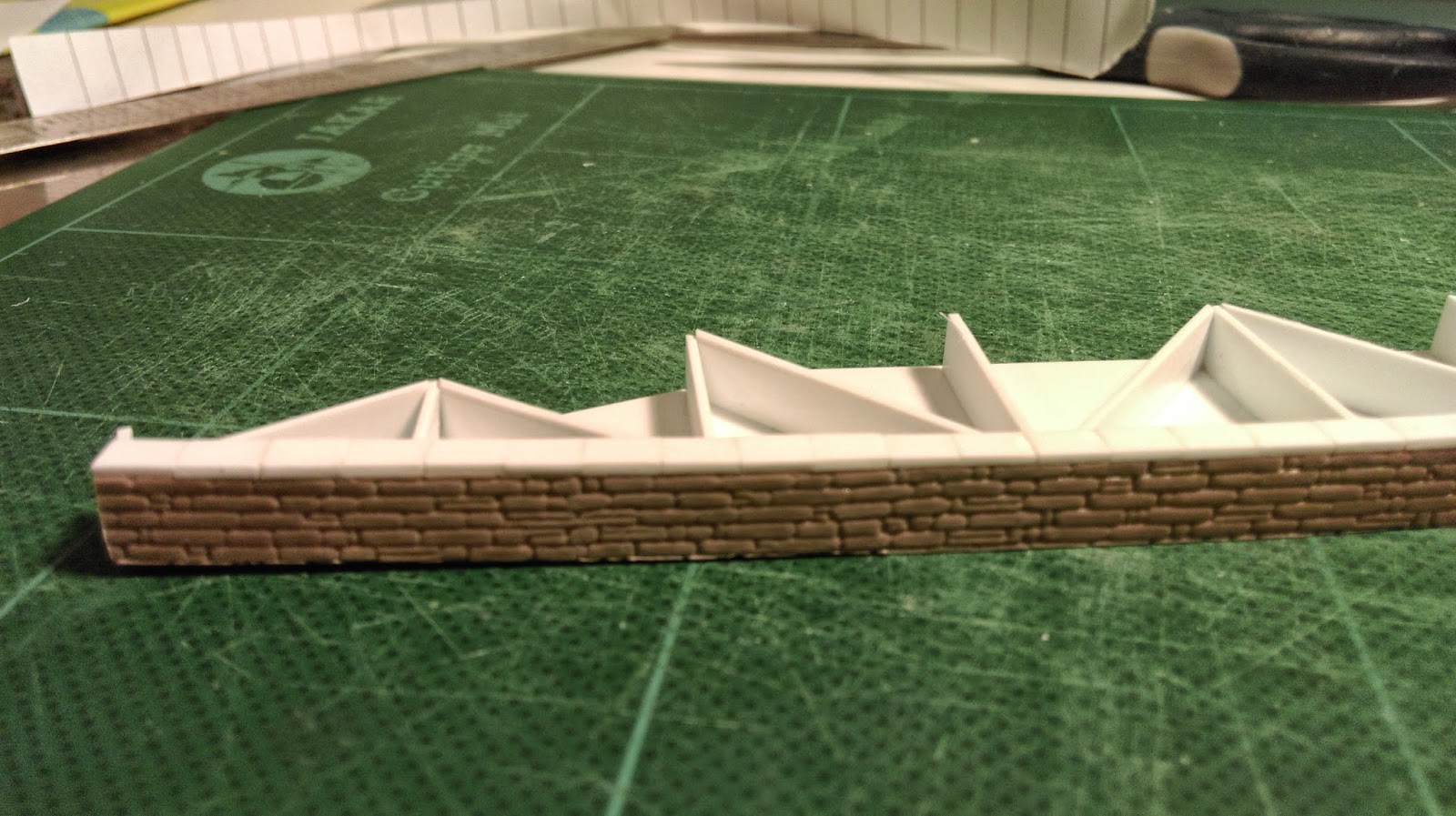
This photo shows how the platforms are constructed from a skeleton of 40 thou styrene sheet, with a facing of Slater's stone sheet. I had this sheet in store, otherwise I would probably have embossed my own stonework in cartridge paper. The coping stones were added individually. After doing this section (the goods yard loading dock), I decided to simply put the coping stones for future sections on top of the platform top surfaces.
Here you see both the front loading dock and down platform in place (temporarily). The platforms are topped with sheets of 30 thou styrene. The dark appearance of the loading dock is an experiment with a piece of wet and dry paper to represent the cinder surface. It looks a bit too neat and tidy so will need some more attention at some point. The rear platform is still in its foam-board state.
The photos below show the up platform, with only the cattle dock outstanding. You also see my mock-up of the exit road bridge. This has a simple styrene underframe (which will be used for the final bridge), and this is temporarily faced with an elevation printed on thin card. I drew it up on QCAD to get the elliptical profile of the arch and wing walls. I'm happy with the mock-up so will now need to recreate the shape in styrene.
Finally, there has been the small matter of taking over editorship of the 2mm Magazine to deal with...

Sunday, 31 August 2014

Lessons from an exhibition


Corrieshalloch made its exhibition debut last weekend at RailexNE in North Shields, albeit as a "work in progress" rather than a finished layout. Overall. I was relieved that it worked pretty well, with the soldering iron having to come out on only two occasions for repairs. A succession of three trains (all of my available locos) supplemented by a class 37 running light engine (courtesy of Mick Simpson) dutifully paraded back and forth. The comments of "oh, look at this one: it's a snowscene" were frequently heard, sometimes intended as a joke but not always. Alisdair Campbell (whose prize-winning Strath made a static cameo appearance) had the inspired idea that we block the line with a snowdrift and suspend operations for an extended lunch break.

One lesson learnt was in the setting up and taking down. It took me a whole hour from close of play to driving away, which seems like a long time given the size of the layout. Although I was working alone, I decided that a lot of time was spent fiddling with nuts, bolts and washers for assembling the legs. As a result, I have now glued washers and nuts to the inside of the legs, and modified the bolts to have a handy wing nut on the outside (photo below). This, coupled with a bit of widening of the holes, should mean that assembly is much quicker and easier in future.

The other major lesson relates to the appearances of the soldering iron alluded to above. Both repairs were to the homemade bolts that connect the fiddle yard turntables. These were originally just soldered to a couple of pcb sleepers glued to the baseboard, but this was far too flimsy to withstand constant use. As pointed out by Mick (after one came off in his hand), heavier engineering is required! So version 2 will see the rails attached to heftier pieces of pcb that are screwed right through the balsa trackbed and into the plywood beneath. Hopefully this will be better. The photo below shows the version 1, as it was at RailexNE.

The turnouts at the entry to the goods yard are also a little bumpy, causing some wagons to couple up again against the operator's will. So another task is to iron out these minor issues with the track.

The good news is that the layout will appear again at Shipley on 20th-21st September, along with the 2mm roadshow, so feel free to pop along and say hello. With any luck, some of the issues above will have been ironed out, and another loco will be in service to boot.

Thursday, 14 August 2014

Quick photo update

As you can see, I've started work on the landscaping, using various offcuts of polystyrene. At the front left there will be quite a steep river gorge, while you can see the beginnings of a hill and roads behing the track formation. The grey square is a planned foundation for some railway workers' cottages.

Tracklaying is complete in the fiddle yard, and I have put on all of the brass tubes for track alignment. However, there is still some wiring to be completed, along with some sort of "end-stop" to prevent disasters...